
‘Soft power’ in a hardening world
Supporting and investing in the high-quality teaching and testing of English is one of the best ways for the UK government to shore up its soft power, said Francesca Woodward, global managing director for English at Cambridge University Press & Assessment.
Francesca Woodward addresses a full house at the joint Cambridge University Press & Assessment and Higher Education Policy Institute event
Francesca Woodward addresses a full house at the joint Cambridge University Press & Assessment and Higher Education Policy Institute event
“English language proficiency remains one of the world’s most important enabling skills, helping learners access education, employment and international opportunities.”
English as soft power tool
Speaking at a Labour Party Conference event in Liverpool, Francesca Woodward urged policymakers to think of the English language as “one of the essential tools in the UK’s soft power toolbox”.
Francesca Woodward, Cambridge's global managing director for English, said: “Bolstering the UK’s world-leading universities and research, our thriving film industry, our globally influential media and publishing sectors, our sporting excellence, our tourism, is our biggest advantage: language.”
"English language proficiency remains one of the world's most important enabling skills, helping learners access education, employment and international opportunities."
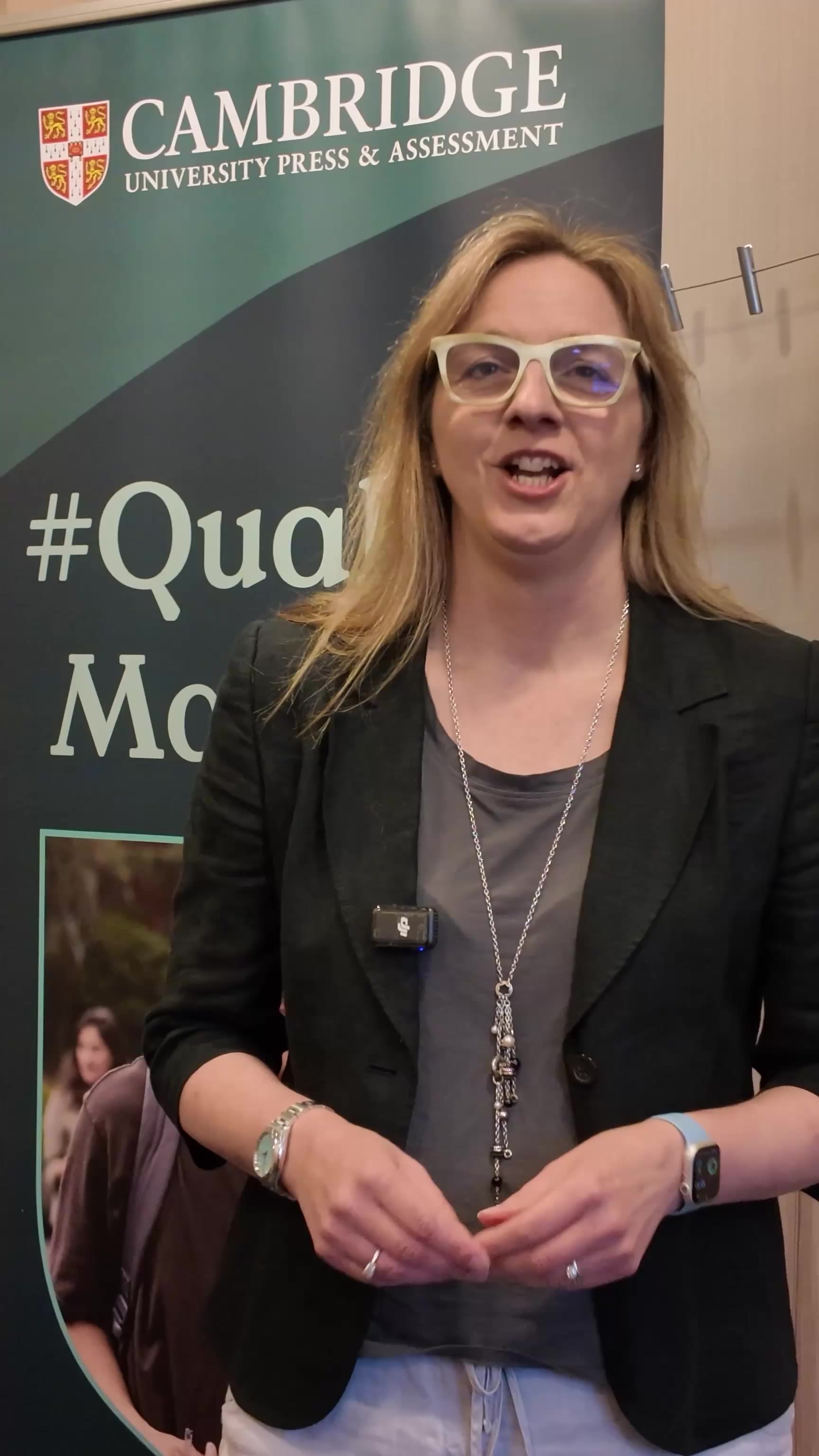
Francesca Woodward, Cambridge's global managing director for English, reflecting on the event
Francesca Woodward, Cambridge's global managing director for English, reflecting on the event
The fringe event — “Soft power in a hardening world: Is the UK making the most of its global assets?” — was co-hosted by the Higher Education Policy Institute (HEPI). It was chaired by Nick Hillman OBE, Chief Executive of HEPI, and marked the launch of HEPI’s annual Soft-Power Index, now in its tenth edition and sponsored by Cambridge University Press & Assessment.
The Index examines which currently serving heads of state and government pursued higher education internationally, and where. The calculation serves as a concrete proxy of countries’ often hard to measure global influence. Since the Index was first published ten years ago, the United States has narrowly overtaken the UK and built up a substantial lead over other countries.
According to this year’s Index, 66 currently serving world leaders were educated in the US and 60 were educated in the UK. France remains in third place, having educated 29 world leaders, while Russia follows in fourth place, with 12. Australia and India tie for fifth place, having educated eight world leaders each.
Sector strategy on soft power
Anyone serious about soft power needs to get serious about universities."
Commenting on HEPI’s Soft-Power Index 2026, Francesca Woodward said: "Anyone serious about soft power needs to get serious about universities. Successful higher education projects global influence. Policymakers would be wise to nurture and support the country's outward-looking universities."
Professor Karen Stanton, Vice-Chancellor of the University of the Arts London, said: “In a much-contested world, influence is not something we can take for granted. Soft power is no longer a byproduct of excellence. It must be a deliberate national strategy.”
The President and Vice-Chancellor of the University of Manchester, Professor Duncan Ivison, remarked that at a time when the UK’s greatest competitors for talent are shutting their doors, the UK faces “not just a once-in-a-generation opportunity, but a once-in-seven-generations opportunity to become the destination for talent, and the place that continues to invest in research and development... The task for the sector is to demonstrate the value we provide and how we contribute to good growth.”
Daniel Zeichner, MP for Cambridge, urged policymakers to “use the huge strength of our soft power to make the case for universities in an increasingly hostile environment.” Ultimately, he said, “universities should be at the heart of answering what kind of country we want the UK to be.”
Reflecting on his own experience of arriving in the UK from Afghanistan as a Chevening Scholar, Dr Naimatullah Zafary said: “We do not just project influence; we heal nations.”

Cambridge's Francesca Woodward on recognising the soft power of higher education.
Cambridge's Francesca Woodward on recognising the soft power of higher education.

Daniel Zeichner, MP for Cambridge, speaking at the event
Daniel Zeichner, MP for Cambridge, speaking at the event
Nick Hillman OBE, Chief Executive of Higher Education Policy Institute (HEPI), introducing the session.
Nick Hillman OBE, Chief Executive of Higher Education Policy Institute (HEPI), introducing the session.
Fran Woodward (right) speaking with Dr Naimatullah Zafary (left)
Fran Woodward (right) speaking with Dr Naimatullah Zafary (left)
From left to right: Daniel Zeichner MP; Dr Naimatullah Zafary; Francesca Woodward; Nick Hillman OBE; Prof Karen Stanton; Prof Duncan Ivison
From left to right: Daniel Zeichner MP; Dr Naimatullah Zafary; Francesca Woodward; Nick Hillman OBE; Prof Karen Stanton; Prof Duncan Ivison
Fran Woodward (centre) chatting with Professor Karen Stanton, Vice-Chancellor of the University of the Arts London
Fran Woodward (centre) chatting with Professor Karen Stanton, Vice-Chancellor of the University of the Arts London
From left to right: Daniel Zeichner MP; Dr Naimatullah Zafary; Francesca Woodward; Nick Hillman; Prof Karen Stanton
From left to right: Daniel Zeichner MP; Dr Naimatullah Zafary; Francesca Woodward; Nick Hillman; Prof Karen Stanton
Daniel Zeichner, Labour MP for Cambridge, speaking at the event.
Daniel Zeichner, Labour MP for Cambridge, speaking at the event.
 Built with Shorthand